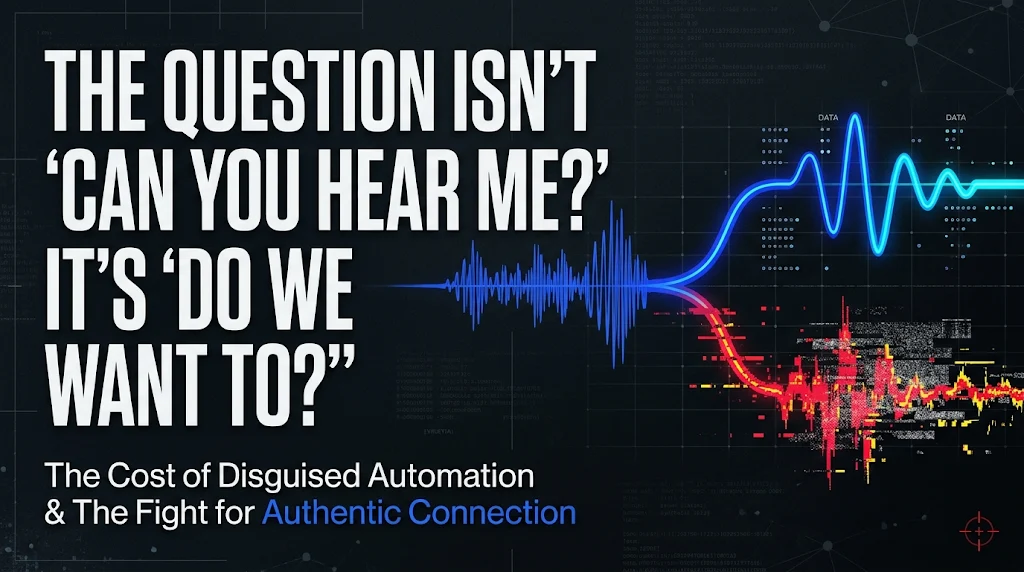
Why disguised outbound voice AI destroys brand equity, triggers carrier blocks, and why zero-latency inbound execution is where automation actually wins.
By Robert Fuller, Founder — Thoughtful Innovations Marketing, Automations, and Consulting
Every afternoon, my phone lights up with a local area code and the exact same synthetic cadence:
“Hello... can you hear me?”
If you manage outbound sales operations, you recognize the script immediately. If you are a business owner or consumer answering the line, your jaw just clenched.
When an automated outbound dialer pauses for half a second upon connection, that dead air is not merely an awkward technical hiccup. It is the exact inflection point where telecom reputation engines flag your caller ID as “Spam Likely” and your customer acquisition cost quietly doubles.
While vendor pitch decks sell infinite outbound scale and zero labor fatigue, nobody is graphing the silent brand erosion occurring across thousands of caller ID screens every week. Here is what the structural data actually reveals.
1. The Mechanics Behind the Pause
The pattern is identical across industries: a spoofed neighborhood area code, a perceptible latency gap, and a bright, pre-recorded or generative opener:
- “Hello... can you hear me?”
- “Hellooo... can you hear me?”
- The double-tap variation: “Hello? Hello?”
Consumer protection analysts and telecom security teams have flagged this exact opener for years. The dialer is rarely checking audio levels. In fraud vectors, it is harvesting a clean biometric sample—a crisp, single-word affirmative (“Yes”). The Federal Trade Commission established years ago that usable voice clones require fewer than five seconds of clean audio; by late 2026 synthesis standards, three seconds of clear speech is plenty.
The Pause Isn’t Latency — The Pause Is the Product.
Even in legitimate B2B sales tech, that connection pause exists as a machine-learning engagement filter designed to separate live humans from voicemail trees before burning compute tokens. Yet all it accomplished at scale was conditioning an entire market to associate half-second silence with immediate deceit.
2. The Product Rule: When the Builder Hangs Up
I engineer, deploy, and audit automation stacks for a living. On a spreadsheet, autonomous outbound AI math looks seductive: unlimited concurrent calls, zero rep burnout, and pennies per dial.
So when my own visceral instinct upon hearing that half-second connection delay is to slam the red button before the voice finishes its first syllable, that signals a fatal architectural flaw.
The Product Rule: When the builder who sells the technology has an instinctive disgust reaction to experiencing it as a buyer, the market reached that boiling point six months earlier. Dashboards stay bright green with outbound dial volume while real brand trust burns to ash.
3. What the Consumer & B2B Data Actually Shows
Aggregated cross-industry sentiment benchmarks (2024–2026) expose the commercial penalty of disguised synthetic outreach:
- 85% of buyers explicitly prefer transparent human interaction over synthetic outreach.
- 93% report that outreach must feel authentic and genuinely accountable to earn commercial consideration.
- 55% immediately downgrade their perception of a brand the moment synthetic disguise is detected.
- 31% disconnect the call within two seconds of detecting artificial pacing or connection latency.
- 90%+ of Better Business Bureau complaints citing AI touchpoints center on missing or deceptive identity disclosure.
This is not anti-technology resistance from Luddites. It is rational pattern recognition by busy decision-makers protecting their time.
Brute-force outbound volume optimizes for the 2.3% who tolerate a synthetic script—while quietly burning brand equity across the 97.7% who flag your domain as spam and never answer again. Stop optimizing for vanity dial metrics. Optimize for baseline trust.
4. The Conversion Lie: Outbound Volume vs. Inbound Velocity
The traditional cold-dialer pitch relies on brute-force volume. But conversion rates do not care about dial volume—they require baseline trust. When you strip away vanity call metrics and measure actual pipeline yield, synthetic cold outbound underperforms.
| Outreach Architecture | Execution Mechanics | Conversion Rate | Next-Step Hold Rate |
|---|---|---|---|
| Traditional Cold Outbound | Standard script (Human or legacy dialer) | ~2.3% | Baseline |
| Autonomous AI Cold Outbound | Zero human touchpoints, disguised voice | 2.3% | 33% |
| Full Human SDR | Authentic, researched manual outreach | 3.8% | 59% |
| Targeted Hybrid Model (Winner) | AI executes zero-latency velocity; human engages trust | +45% Yield Lift | 74%+ |
Where AI Voice Truly Wins: The 60-Second Inbound Window
Autonomous voice and SMS workflows outperform humans in one unmistakable operational scenario: zero-latency inbound execution.
When a homeowner’s AC fails at 6:15 PM, or a facility manager submits a commercial quote request after hours, high intent exists right now. If that inquiry sits in an inbox until 9:00 AM, the buyer has already booked the competitor who responded first. Deploying automated intake on ring one—or triggering an instant SMS and callback within 60 seconds of a web form submission—yields a 200% to 400% conversion lift over a human callback arriving two hours late.
“When the builder who sells the technology has an instinctive disgust reaction to experiencing it as a buyer, the market reached that boiling point six months earlier.”
5. Legal Realities & Carrier Reputation Filtering
Treating synthetic voice as an unregulated growth hack is over:
- FCC TCPA Classification: AI-generated voices are legally classified as “artificial voices” under the Telephone Consumer Protection Act, closing legacy regulatory loopholes.
- One-to-One Consent Mandates: Bundled, multi-partner lead lists with pre-checked boxes fail compliance standards. Direct, single-seller consent is mandatory.
- Carrier Reputation Destruction: Even if you evade statutory fines, carrier analytics engines (Hiya, First Orion, TNS) detect high-frequency short-duration calls and cadence anomalies rapidly. Once a business number is tagged “Spam Likely,” remediation takes months and poisons legitimate operational calls.
6. What Considered Automation Looks Like
Automation fails when it pretends to be human. It wins when it eliminates operational friction transparently.
- Answer on Ring One: Never dump an inbound prospect into a clunky 6-option phone tree or dead voicemail box.
- Disclose Identity Immediately: Lead with clarity: “Hi, I’m the automated scheduling assistant for [Company]. I can get you routed to the right specialist in 20 seconds, or take your details for an immediate callback—how would you prefer to proceed?”
- Execute Clean After-Hours Triage: Collect job urgency, location, and contact details transparently, then send a live calendar booking link via SMS before the caller hangs up.
- Hand Off Fast: Gather two qualifying data points, verify intent, and route hot opportunities directly to a live human decision-maker.
The Real Question for Operators
Every revenue operator needs to audit their dashboards against operational reality: Are you tracking the 2.3% who tolerated an outbound script, or the 97.7% who marked your domain as spam and will never answer again?
Stop Losing High-Intent Inbound Leads in the Cracks
You don't need more outbound noise or another bloated software subscription. You need an intake and follow-up engine that captures every inbound inquiry in under 90 seconds—without replacing your existing CRM or phone system.
Get the $250 Tech Stack & Pipeline Diagnostic →